Understanding Plant Stress During Exterior Cleaning
Why Plant Protection Is Essential and Why Some Plant Stress May Still Occur
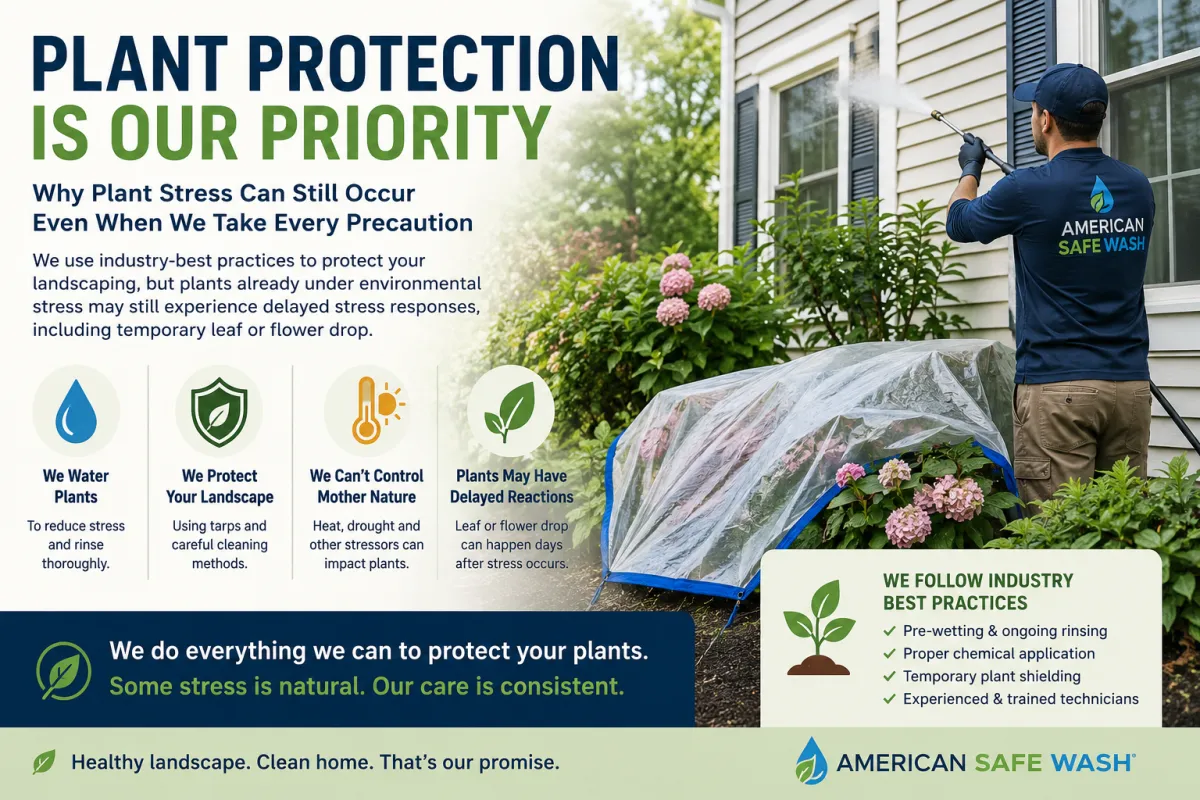
At American Safe Wash, protecting your landscaping is one of our highest priorities. We understand that your plants, shrubs, flowers, and trees are a valuable part of your property, and we take extensive precautions to help protect them during every exterior cleaning service.
Our technicians are trained to follow industry-recognized plant protection procedures, which may include:
Thoroughly pre-wetting surrounding vegetation
Continuous rinsing of plants during cleaning when appropriate
Careful control of cleaning solution application
Temporary shielding of sensitive plants when necessary
Post-service rinsing of landscaping
Ongoing technician training in landscape protection
These practices significantly reduce the risk of plant injury and represent the current industry standard for protecting vegetation during exterior cleaning.
Understanding Plant Stress
Plants are living organisms that constantly respond to changes in their environment.
Long before an exterior cleaning service takes place, a plant may already be experiencing stress from factors such as:
High temperatures
Drought or prolonged dry conditions
Heat reflected from roofs, siding, concrete, and pavement
High UV exposure
Wind
Root damage
Disease or insect pressure
Recent transplanting
Nutrient deficiencies
Seasonal environmental changes
Collectively, these conditions can place a plant into what horticulturists refer to as water stress or environmental stress.
Unlike people, plants cannot relocate when conditions become unfavorable. Instead, they activate natural survival mechanisms designed to conserve water and energy until growing conditions improve.
How Plants Naturally Respond to Stress
One of the most common misconceptions is that every leaf or flower that drops after work has been performed was caused by that work.
In reality, many plant responses occur days or even weeks after the original stress event.
When environmental stress becomes significant, plants naturally begin conserving resources by redirecting water and nutrients to the portions of the plant most critical for survival.
As part of this process, plants may:
Wilt temporarily
Curl their leaves
Develop brown leaf margins
Drop flowers or buds
Shed older leaves
Slow new growth
Botanically, this natural process of shedding leaves or flowers is called abscission. When triggered by environmental conditions such as drought or extreme heat, it is commonly referred to as stress-induced leaf abscission.
Rather than indicating permanent damage, leaf drop is often the plant's way of reducing water loss and improving its chances of surviving difficult environmental conditions.
Why Can Leaf Drop Occur After a Cleaning Service?
This is one of the questions we receive most often.
Many homeowners assume that if leaves begin dropping shortly after an exterior cleaning, the cleaning itself must have caused the problem.
However, plant physiology is often more complex.
Scientific research has shown that plants already experiencing drought or heat stress may continue developing visible symptoms after the original stress has occurred. In fact, delayed leaf drop is a well-documented response as plants continue adjusting their internal water balance and hormone levels.
This means that symptoms may appear days after periods of:
Extreme heat
Water shortages
Drought
Rapid temperature changes
Other environmental stressors
The timing of visible symptoms does not always identify the original cause of the stress.
Why We Water Plants
One of the most effective methods of reducing plant stress during exterior cleaning is proper watering.
For this reason, our technicians routinely pre-wet surrounding landscaping and continue rinsing vegetation throughout the cleaning process when appropriate.
Watering helps by:
Diluting incidental cleaning solution
Cooling leaf surfaces
Maintaining soil moisture
Reducing additional environmental stress during service
However, watering cannot instantly reverse days or weeks of existing drought stress.
Just as a dehydrated person does not fully recover after drinking one glass of water, a plant recovering from prolonged heat or drought may continue exhibiting stress responses while it gradually restores its internal water balance.
Why We Sometimes Use Temporary Plant Covers
In certain situations, temporary coverings may be used to shield particularly sensitive vegetation during portions of the cleaning process.
These coverings are:
Used only when appropriate
Closely monitored
Removed as soon as practical
Used in conjunction with watering, not as a replacement for it
Temporary protection is intended to minimize exposure during cleaning while avoiding unnecessary prolonged coverage.
Our Commitment to Plant Protection
Our objective is simple.
Leave your home cleaner while protecting your landscaping with the highest level of care reasonably possible.
Although no exterior cleaning company can guarantee that every plant will remain completely free from environmental stress, especially during periods of drought or extreme heat, we are committed to following industry best practices that significantly reduce risk.
It is important to understand that even when industry-standard plant protection practices are followed, plants that are already under environmental stress from heat, drought, disease, transplant shock, insects, nutrient deficiencies, or other factors may still exhibit delayed stress responses, including temporary leaf or flower drop.
These natural biological responses can occur independently of exterior cleaning and are recognized throughout horticultural science.
Our commitment is to minimize risk through proper procedures, experienced technicians, and thoughtful care of your property every step of the way.
Learn More from Trusted Horticultural Sources
The information above is supported by research from respected horticultural and scientific organizations. If you would like to learn more about plant stress and natural leaf drop, we encourage you to review the following resources.
USDA Forest Service
Research discussing drought stress and its effect on natural leaf abscission (leaf drop).
https://research.fs.usda.gov/treesearch/15699
ScienceDirect
Leaf Abscission
A comprehensive overview of the biological process by which plants naturally shed leaves in response to environmental conditions.
https://www.sciencedirect.com/topics/agricultural-and-biological-sciences/leaf-abscission
National Library of Medicine (NIH)
Research describing how drought stress and subsequent recovery can activate plant hormones involved in natural leaf abscission.
https://pmc.ncbi.nlm.nih.gov/articles/PMC1075527/
University Extension Services
Homeowner-friendly guidance on drought stress, watering practices, and plant health can also be found through:
UConn Extension
Clemson Cooperative Extension
NC State Extension
Texas A&M AgriLife Extension
University of Florida IFAS Extension